Behind the Scenes
Crafting Excellence: Inside Our Manufacturing Process

Most mattress marketing describes the finished product. This describes how it gets made, because that is where consistency across a 500-unit order is actually won or lost.
It starts with the foam, not the mattress
Foam is not a commodity. Two blocks that look identical can differ by 30% in density, and density is what determines whether a mattress still holds its shape in year four. We work to specified densities per grade and per application — the foam in a pillow, a sofa cum bed and a mattress comfort layer are three different specifications, not one material used three ways.
Blocks are cured before they are cut. Cutting foam too early is a common shortcut; it produces a sheet that continues to change dimension after it has already been built into a mattress.
Cutting to the order, not to a chart
Sizes are cut per order. This sounds inefficient and it is — it is also the only way to supply a hotel whose bed frames are 78 by 66 inches because that is what a carpenter built in 2009. Cut-to-size is the default rather than a special request, which is why our size chart is a starting point rather than a constraint.
Building the stack
Layers are assembled in sequence: support core, transition layer, comfort layer, quilt. Adhesive is applied at controlled coverage — too little and layers shear apart under use, too much and the bond stiffens the mattress and blocks airflow through it.
Checks along the line
- Foam density verified per batch before cutting
- Dimensional check after cutting, against the order sheet
- Layer sequence and adhesive coverage checked at assembly
- Stitch and seam inspection after quilting
- Final dimension, finish and labelling check before packing
Quilting and cover assembly
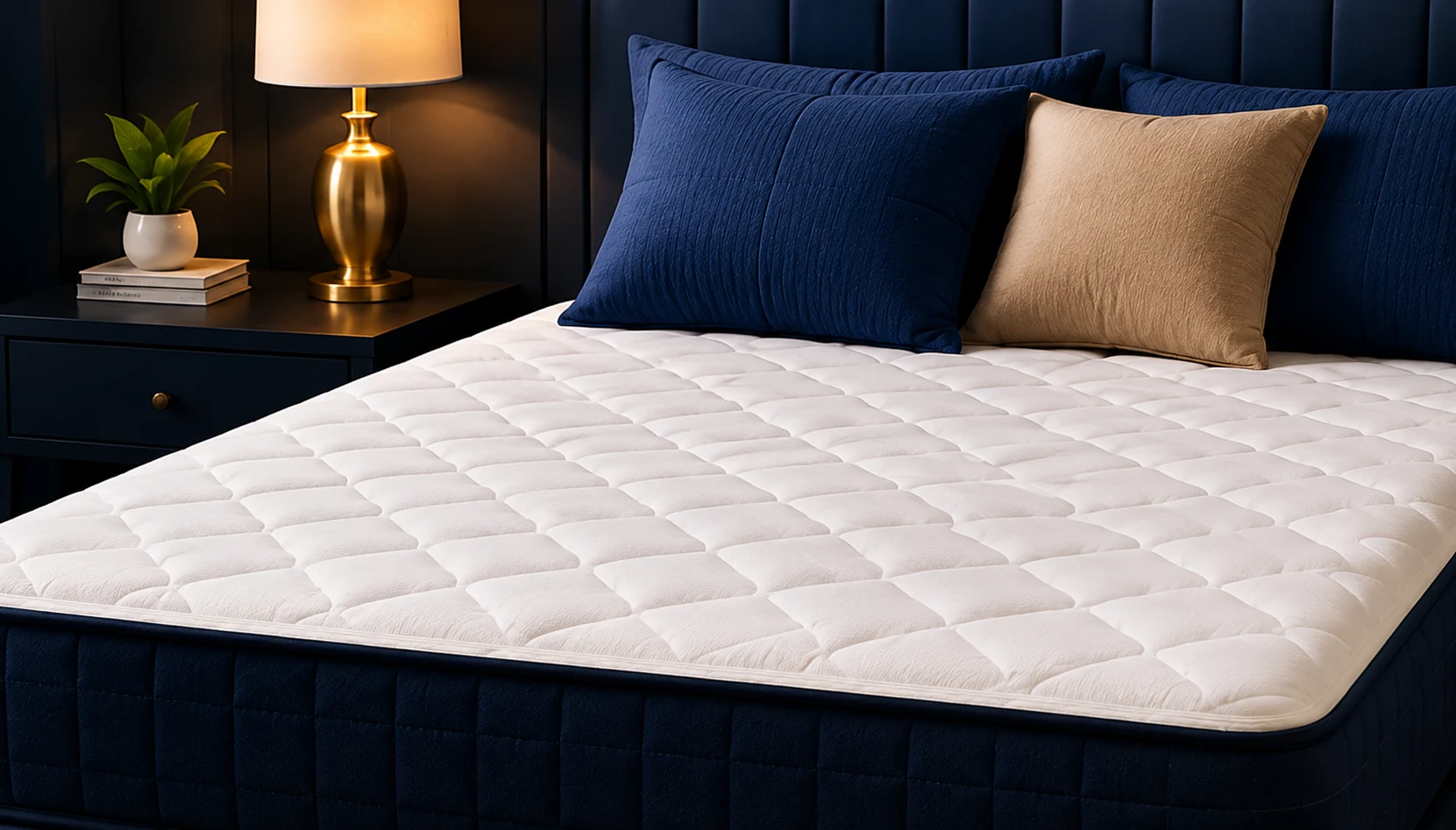
The quilt is where a mattress starts to look like a product. It also does structural work: it holds the top comfort layer in place so it cannot migrate. A loose or uneven quilt produces the ripples you see on a mattress that has been in service for a year.
Covers are cut, quilted, joined and fitted as a unit. Seam alignment at the corners is the tell — it is the hardest part to get right and the first thing an experienced buyer looks at.
Inspection is a stage, not a step at the end
Checking only at the end of a line means a foam density problem is discovered after 500 mattresses have been built around it. Checks sit at each stage instead: incoming material, post-cut, assembly, post-quilt, and a final inspection before packing.
Consistency is not a quality you add at the end. It is the accumulation of every stage where you refused to let something marginal through.
Packing for the journey it will actually take
A mattress that leaves the plant perfect and arrives compressed against a truck wall has still failed. Packing is specified for the despatch: sealed against dust and moisture, protected at the corners, and labelled so that the receiving team can sort a mixed-size delivery without opening anything.
Why this matters to a bulk buyer
For a single mattress, process discipline is invisible. For 500 units across four sizes going to a hotel that will install them over two phases, it is the entire value of the supplier. Phase two has to match phase one, and it only does if the specification was recorded and repeated rather than remembered.
Our minimum is 50 units per size, with a typical lead time of 10 to 15 working days from confirmation and despatch across India. If you would like to discuss a specification, or visit the plant and see the line, we would rather you came and looked.